Repeat Calls #
The Repeat Calls view identifies customers who contact you multiple times within a short period — a pattern that almost always signals an unresolved issue. When a customer calls back, it means your first attempt to help them did not succeed, representing both a customer satisfaction risk and an opportunity to improve.
Why Track Repeat Calls? #
Measuring first-contact resolution — repeat calls are the inverse of first-contact resolution (FCR). High repeat call volume indicates that your team is not resolving issues the first time, forcing customers to call back and frustrating them in the process. Tracking repeat calls helps you identify where resolution is breaking down.
Identifying chronic problems — when multiple customers call back about the same issue (a billing error, a product bug, confusion about a feature), it signals a systemic problem that affects many people. Repeat call patterns surface these issues quickly, allowing you to fix the root cause rather than treating symptoms.
Understanding customer frustration — customers who call back are often more frustrated than those who don't. Reducing repeat calls directly improves customer satisfaction and loyalty.
Detecting knowledge and training gaps — if repeat calls cluster around specific call types or are handled by particular users, it suggests gaps in knowledge or training. These calls become coaching opportunities and training priorities.
Reducing operational cost — every repeat call consumes resources (queue time, user time, infrastructure) without creating value. Even modest improvements in first-contact resolution have significant cost savings, especially when multiplied across many calls.
Improving product and process — some repeat calls indicate product issues, confusing processes, or unclear communication to customers. These insights drive product improvements and process redesigns that benefit all customers, not just those calling back.
Using the Repeat Calls View #
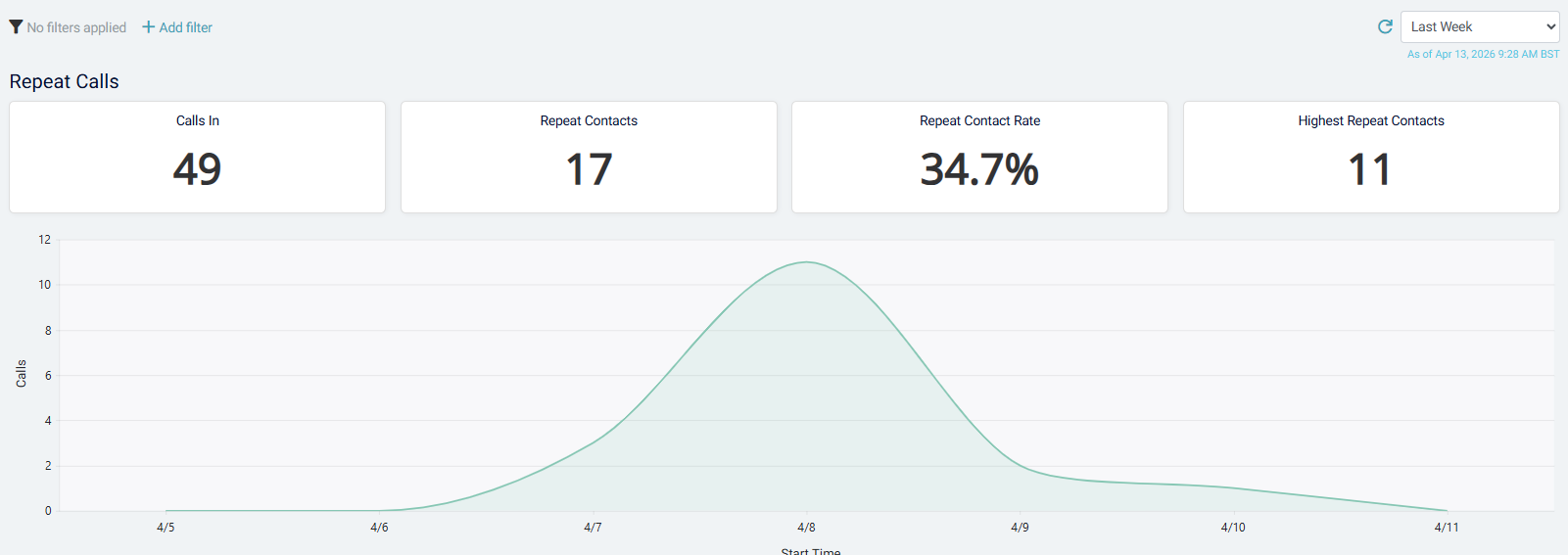
The view displays customers who have called multiple times within your chosen timeframe, showing:
- Customer — who called back
- Number of calls — how many times they contacted you
- Call dates — when each call occurred (helping you see the pattern and urgency)
- Call types or queues — which departments or issue types they called about
- Time between calls — how quickly they called back (same day, next day, etc.)
Finding patterns — use filters and date ranges to identify:
- High-repeat customers — which customers are calling back most frequently? Are they always about the same issue?
- Same-issue repeats — filter by call type or queue to see whether customers are calling back about the same problem. This is a critical signal that issues are not being resolved.
- Repeat rates by queue or user — which teams have higher repeat call rates? Which individuals handle calls in a way that prevents callbacks?
- Time-window repeats — adjust the timeframe (last 7 days, 30 days, 90 days) to understand whether repeat calls happen immediately (suggesting frustration) or over longer periods (suggesting customers try to resolve on their own first, then return).
Reviewing call sequences — click on a customer to see their call history. Listen to recordings and review transcriptions to understand:
- What was the original issue and how was it handled?
- Did the user ask diagnostic questions, or did they assume they understood the problem?
- Was the customer satisfied at the end of the first call, or did they express lingering doubts?
- What was the issue in the second call — the same problem or a new one?
Taking action on repeat calls — the goal is to reduce them. Strategies include:
- Immediate follow-up — reach out to customers who called back to understand what went wrong on the first call and rebuild confidence
- Root cause analysis — for issues that generate many repeat calls, investigate the underlying cause (broken process, unclear communication, product defect) and fix it
- Coaching — if a user has high repeat call rates, review their calls to identify where resolution is breaking down and provide targeted coaching
- Process improvement — if a call type consistently generates repeats, redesign the handling process or provide better tools to users
tip
Segment repeat calls by time window: customers calling back same-day are highly frustrated; customers calling back within a week had time to attempt the solution and it failed; customers calling back after a month may have encountered a related issue. Each segment requires a different response strategy.